
Готуємося до ЗНО. Написання листа . Види листів (3год)
Виконай тести за підручником Підготовка до ЗНО , тест №3,4,5
Прочитай листи с.370-375
Напиши два листа : Лист-запит та Лист-заява
Другий навчальний тиждень карантину (29.03-3.04)
Готуємося до ЗНО . Оголошення , реклама...(3 год)
Виконай тести за підручником Підготовка до ЗНО , тест №6
(див. матеріали блогу)
Some people say that advertising encourages us to buy
things we really do not need. Others say that advertisements tell us about new
products that may improve our lives. Which viewpoint do you agree with? Use
specific reasons and examples to support your answer.
I
think that everyone can divide all advertising products and services into
useless ones and useful ones. It is like looking through an information desk
when you pay attention to those messages that interest you. Take me for
example.
I
do not like jewelry. It does not mean I do not have it at all, I have a couple
of inexpensive rings as gifts from my parents. I just think, people pay too
much attention to this stuff. I believe it is the result of mass advertising.
Every day when I am watching TV, listening to the radio or reading the paper I
notice many ads about getting an expensive ring, chain, necklace or ear-rings.
From my point of view these kinds of advertising contaminate people's minds. In
this case you are encouraged to buy things you do not really need. They make
you believe you need such products in order to succeed or be happy.
From
the other side, I think that advertisements of the new detergents with
up-to-date formulas to help you maintain your cloth in perfect conditions, the
new cars with some extra futures that make your traveling more comfortable and
sports goods that make your life healthier may help you to improve your life.
Recently
my husband and I saw an ad on the Internet about a very interesting and inexpensive
vocation to Japan for a week. Is not it awesome? We like traveling. So now we
are planning to find out more about it and, may be, make reservations. I belief
that without advertisements we would be unaware about plenty of oppotunities
that may make your life happier, easier and less stressful.
My
point is that every person has his own scale of values. So if he is vegetarian
he will consider an ad about meat products useless for him.
Прочитай есе про рекламу, виділи маркери , напиши власне есе, як ти ставишся до реклами за поданим зразком!!!
Третій навчальний тиждень карантину ( 6.04-10.04)
Готуємося до ЗНО . Написання листа , анотації (3 год),
Виконай тести за підручником Підготовка до ЗНО , тест № 7
(див. матеріали блогу)
Вашій увазі пропонується список англійських прийменників за алфавітом, що є найуживанішими. Вони розбиті на 4 таблиці: прості, похідні, складні та складені.
Прості
| aboard | на кораблі, на борту |
| about | навколо, поблизу |
| above | поза, над, вище |
| absent | без, за відсутності (амер.) |
| across | через, крізь, поперек |
| afore | перед, попереду |
| after | аісля, позаду |
| against | проти, біля, до, навпроти |
| along | уздовж, повз |
| amid | поміж, посеред |
| amidst | посеред, серед |
| among | між, посеред |
| amongst | крізь, поміж |
| around | навколо, по, біля |
| as | як |
| aside | осторонь |
| aslant | через, поперек |
| astride | верхи на |
| at | в, у, на |
| athwart | проти, всупереч |
| atop | над, поверх |
| bar | за винятком, крім |
| before | до, перед |
| behind | пзаду, після |
| below | під, нижче |
| beneath | нижче ,під |
| beside | близько, біля |
| besides | зовні, крім |
| between | між |
| betwixt | серед |
| beyond | поза, по ту сторону |
| but | крім, за виключенням |
| by | біля, повз, поруч, через |
| circa | приблизно, біля |
| despite | не дивлячись на |
| down | вздовж, униз, через |
| except | крім, виключаючи |
| for | заради, на, о, по, протягом |
| from | з-за, у |
| given | за умов |
| in | в, на, через, протягом |
| inside | всередині, з внутрішньої сторони |
| into | в, на |
| like | наче як, схоже на |
| mid (від “amid”) | між, посередині |
| minus | без, мінус |
| near | біля |
| neath | нижче, під |
| next | біля, поруч з |
| notwithstanding | на дивлячись на |
| of | від, до, з, про, щодо |
| off | від, з-за, із |
| on | на, в, після |
| opposite | навпроти |
| out | за, з |
| outside | поза, зовні, за межами |
| over | через ,над |
| pace | з дозволу |
| per | через, завдяки, за, на |
| plus | з, плюс |
| post | після |
| pro | заради, для |
| qua | в якості, як |
| round | коло ,на, біля |
| save | виключаючи, крім |
| since | після, з деякого часу |
| than | ніж, порівняно з |
| through | через, включно, крізь, протягом |
| till | до |
| times | на |
| to | до, без, на, в |
| toward | до, над, щоб, щодо |
| towards | до, на, під, щоб, щодо |
| under | під, нижче, при |
| underneath | під |
| unlike | на відміну від |
| until | до |
| up | угору, до |
| versus (скор. «vs.») | проти, порівняно з |
| via | через |
| vice | замість |
| with | з, на, навкруги, до ,від, для |
| without | без, зовні, крім, не рахуючи |
Похідні
| barring | за винятком, крім |
| concerning | відносно |
| considering | беручи до увахи, враховуючи |
| depending | в залежності від |
| during | під час, протягом |
| granted | за умови |
| excepting | виключаючи, за виключенням |
| excluding | за виключенням |
| failing | за відсутністю |
| following | після, слідом за |
| including | включаючи, в тому числі |
| past | після, за, по той бік, повз |
| pending | протягом, до, чекаючи |
| regarding | відносно, стосовно, щодо |
Складні
| alongside | біля, поблизу, поруч |
| within | всередині, в межах |
| outside | за винятком, за межами, поза |
| upon | після, на |
| onto | на, в |
| throughout | на протязі, через, по всій довжині |
| wherewith | за допомогою чого |
Складені
| according to | відповідно до |
| ahead of | попереду, до |
| apart from | не дивлячись на |
| as far as | ще, наскільки |
| as for | що стосується |
| as of | починаючи з, від (дати) |
| as per | відповідно |
| as regards | що стосується |
| aside from | за виключенням, за винятком |
| as well as | крім, разом з |
| away from | за відсутності, від |
| because of | через те що, тому що |
| by force of | в силу |
| by means of | за допомогою |
| by virtue of | завдяки |
| close to | рядом з, близько до |
| contrary to | всупереч, проти |
| due to | завдячки, через те що |
| except for | крім |
| far from | далеко від |
| for the sake of | заради |
| in accordance with | згідно з |
| in addition to | на додаток до |
| in case of | у випадку |
| in connection with | у зв’язку з |
| in consequence of | як результат, в результаті |
| in front of | перед |
| in spite of | не дивлячись на |
| in the back of | позаду |
| in the course of | протягом |
| in the event of | у випадку, якщо |
| in the middle of | посередині |
| in to (into) | на, в |
| inside of | протягом |
| instead of | замість |
| in view of | зважаючи на |
| near to | поблизу до |
| next to | поблизу до |
| on account of | через, за рахунок |
| on to (onto) | на |
| on top of | зверху, на вершині |
| opposite to | проти, навпроти |
| out of | з-за, з середини |
| outside of | за межами |
| owing to | через, завдяки, завдячуючи |
| thanks to | завдячуючи |
| up to | по, аж до |
| with regard to | відносно, щодо, стосовно |
| with respect to | щодо |
. Вставте прийменники, де необхідно
1. Women are afraid … rats.2. ‘What do you complain …?’ asked the doctor.
3. When I finished school I entered … the university.
4. What are you laughing …?
5. When I was a child I was often asked … my mother to look … my little sister when my parents were … work.
6. They didn’t want to listen … me.
7. Wait … me. I’ll be back … a few minutes.
8. I’m sorry, I can’t speak … you now. The professor is waiting … me. I must go … the institute to explain … him saome details … my work. Come … the
evening, I’ll try to answer … all your your questions.
9. Turn … the corner … the house and look … the flowers grown … my mother. Aren’t they beautiful?
10. All students look … the summer holidays.
11. What are you afraid …? – I can’t answer … your question. You will surely laugh … me.
12. She is a good student, and the teachers never complain … her.
13. We tried to speak … him but he didn’t want to listen … us. He didn’t even look … us and didn’t answer … our questions.
14. At the end … the street she turned … the corner, walked … the bus-stop and began waiting … the bus.
15. Don’t laugh … your smaller brother!
За поданим посиланням прочитай лист, який отримав 200 балів, уважно прочитай завдання до поданого листа https://znoclub.com/inshe/788-zno-z-anglijskoji-movi-20-tem-dlya-zavdannya-z-rozgornutoyu-vidpoviddyu.html
На цьому ж сайті , діти, Ви можете знайти різні шаблони та завдання для написання листа,есе,і т.д.
Ваше творче завдання на цей тиждень!!!! Зайдіть за посиланням на 20 тем до написання ЗНО!!! Та виконайте завдання №4
Четвертий навчальний тиждень карантину (13.04-17.04)
Готуємося до ЗНО. Розгляд англійських ідіом, тренуємо слухання
Кілька слів про ідіоми
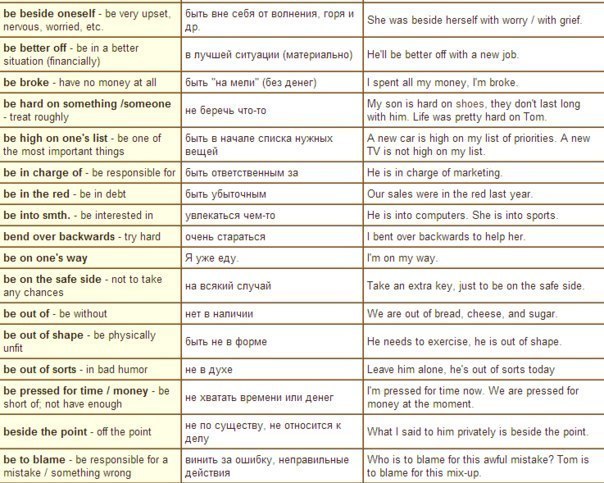
Ідіоми або фразеологізми – це саме ті конструкції, які прикрашають будь-яку мову, роблять її яскравою і неповторною, а головне – заплутаною і незрозумілою для іноземців, які намагаються її вивчити. Ідіоми – головний біль перекладачів, які не упускають можливості повеселити носіїв мови дослівним перекладом кожного слова. Уявіть, як можна пояснити іноземцю, що конкретно означають наші фразеологізми: «собака зарита», «зарубай собі на носі», «кіт наплакав», «воду варити»? Так само ми дивуємося, коли чуємо деякі ідіоми, які люблять вживати в мові як британці, так і американці.
Ми вже розповідали про ідіоми, які потрібно знати дітям, сьогодні розповімо про 30 найпоширеніших ідіом в англійській мові, які ви зможете використовувати в процесі живого спілкування.
ТОП-30 ідіом в англійській мові
Apple of one’s eye – зіниця ока, світло очей. Цю ідіому можна використовувати якщо говорите про щось дуже важливе для вас, дороге.
Half-запечені – буквально «недопечений». Іноді використовується і в прямому сенсі – якщо мова про пироги, але частіше – в переносному сенсі, коли хочете сказати, що справа ще недопрацьована, сира. Часто використовується, коли говорять про проект – він не готовий, не допрацьований, сируватий.
Be like chalk and cheese – абсолютно різні. Причому тут крейда і сир – сказати важко, але, погодьтеся, крейда і сир дійсно – абсолютно різні.

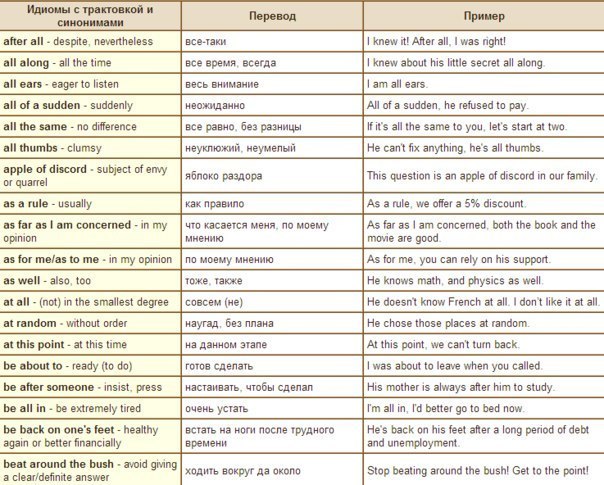
Fish out of water – буквально «вийнята з води риба», не в своїй тарілці, некомфортна ситуація.
Happy as a clam – бути задоволеним, щасливим, в хорошому настрої. В українській мові є схожий вираз: «Задоволений, як слон»
Break a leg – ні пуху, ні пера. Трохи дивне побажання удачі перед важливою подією в житті (іспитом, наприклад). Не дивуйтеся, якщо ви, вирушаючи на співбесіду або іспит, почуєте навздогін підбадьорююче «Break a leg» – друзі зовсім не бажають, щоб ви зламали ногу.
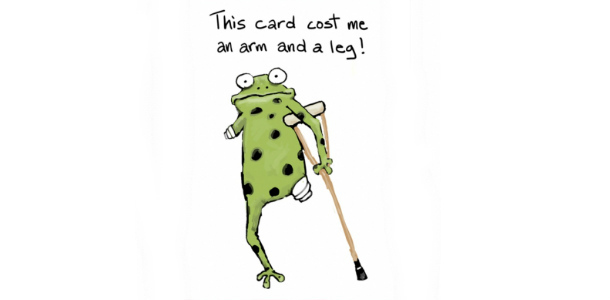
Cost an arm and a leg – про високу вартість речі. Ідіома допоможе вам висловити обурення з приводу завищених цін в магазині або невеликий сувенірній крамничці під час екскурсії.
A piece of cake – дуже проста справа, задача. Часто вживається в реченнях про завдання, яке легко виконати, проблему, яку не складно вирішити.
Easy peasy, lemon squeeze – британський аналог американського виразу «A piece of cake».
You can not judge a book by its cover – буквально «ви не можете обрати книгу за обкладинкою», використовується, коли ви хочете сказати, що не варто приймати рішення на підставі тільки видимих, зовнішніх факторів.
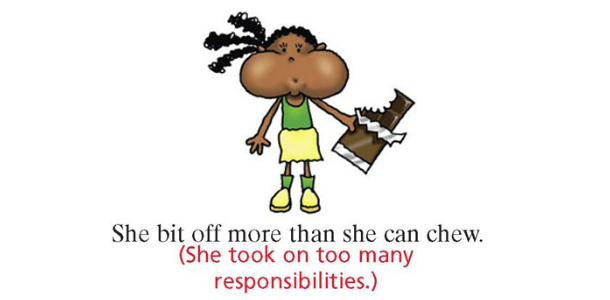
Bite off more than you can chew – брати занадто багато зобов'язань на себе. Буквально – відкусити більше, ніж зможеш проковтнути.
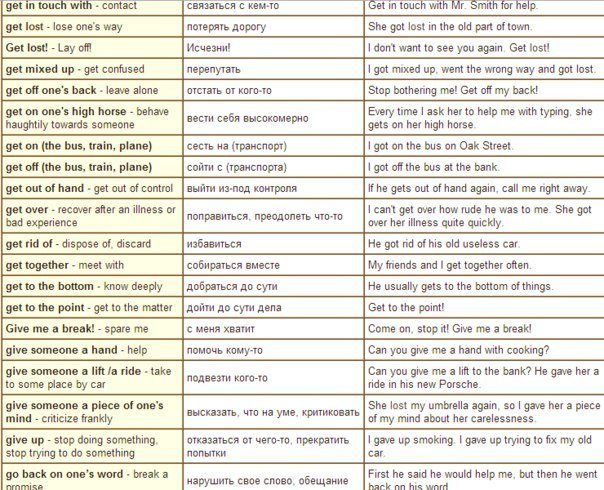
Add fuel to the fire – погіршення і так поганої ситуації. Можна сміливо використовувати в розмові про політику чи футбол. У нас є схожий вираз «підлити масла у вогонь», що означає «посилити і так погану ситуацію».
Cry over spilt milk – не варто засмучуватися через те, що вже не повернути (плакати за збіглим молоком)
To be in the same boat – в одному човні, в однаковому становищі, брати по нещастю (щастю)
To be broke – на мілині.
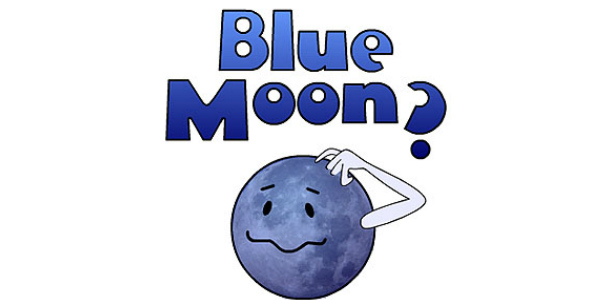
Once in a blue moon – те, що відбувається дуже рідко, про виключну подію, яка може статися раз у кілька сот років.
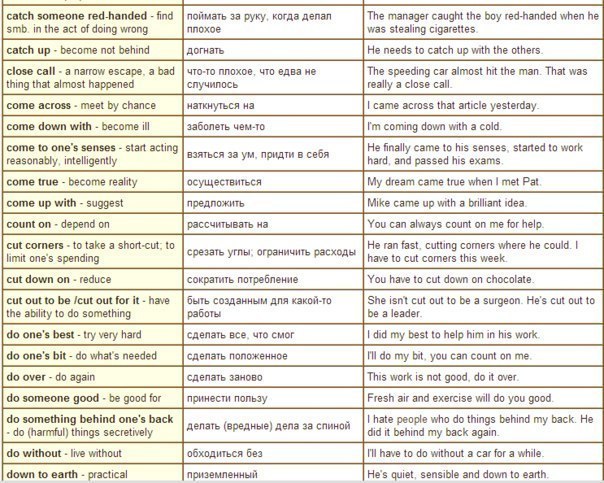
Over My Dead Body – тільки через мій труп.
When Pigs Fly – буквально «коли свині навчаться літати», у нас є схоже вираз «коли рак на горі свисне».
A Leopard Can not Change His Spots – про те, що потрібно приймати людину такою, якою вона є. Буквально «Леопард не може змінити своїх плям»
Wear Your Heart on Your Sleeve – виражай емоції вільно, відкрий серце.
Foam at the Mouth – в стані люті, з піною біля рота.
Head Over Heels – закохається по вуха.
It is not my cup of tea – це не моє, не в моєму смаку, буквально «не моя чашка чаю».
The neighbor's grass is greener '– у сусіда трава зеленіша, завуальоване вираз заздрості.
Every dog has his day – є схоже вираження в російській мові: «буде і на нашій вулиці свято».
It's Greek to me – про незрозуміле, це китайська грамота для мене.
Ball and chain – буквально «чавунна куля на нозі каторжника», тягар. Часто використовується в розмові про дружину:)
To be in the red – бути збитковим. Походження ідіоми пояснюється досить просто: в бухгалтерії витрата пишеться червоними кольором, а прибуток – чорним. Звідси і ж Black Friday.
All in a good time – всьому свій час.
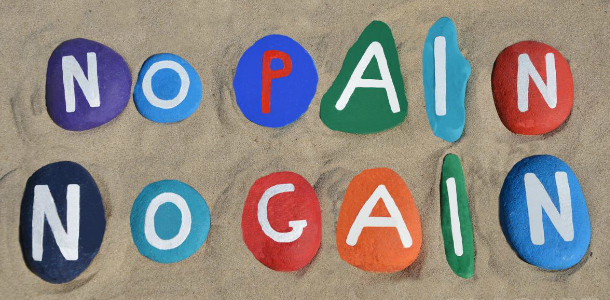
No pain, no gain – без болю немає прогресу, в російській мові є схожі виразу «під лежачий камінь вода не тече», «без праці не витягнеш рибку зі ставка» і т.д.
Використовуйте ідіоми в своєму мовленні – таким чином ви зробите його більш насиченим, емоційним, багатим і яскравим. Щоб запам'ятати ідіоми, варто скористатися 6 способами запам'ятовування нових слів або практикувати їх використання на заняттях розмовних клубів.
Бажаємо успіхів!
Переглянь цікаві відео про ідіоми!!!
Твоє завдання обрати 10 ідеом та побудувати з ними прикольні речення, читаючи буду оцінювати Вашу неординарність та яскравість!!!! На ЗНО це також додає бали за останнє завдання!!!!
За цим посиланням прошу послухати аудіювання та виконати тести робочого зошита, а також виконати тести на читання та письмо!!! Це і буде завдання 5-го тижня карантину за період 21-24 квітня.
6-ий тиждень карантину( 27.04-30.04)
Готуємося до ЗНО.Повторюємо граматичні часи, тренуємо написання листа
Пригадаємо ще раз граматичні часи за поданою табличкою
Простий
час (Simple)
Приклад
|
||||
Тривалий час(Continuous)Приклад
|
Future ContinuousI will be writing a letter at this time tomorrow.
Завтра в цей час я писатиму листа. |
Не said he would be writing a letter at that time the
next day.
Він сказав, що завтра в цей час писатиме листа. |
||
Доконаний часПриклад
|
Past PerfectBy the time you came I had written a letter.
До того часу як ти прийшов, я написав листа. |
|
Future in the Past PerfectНе said he would have written a
letter to her by the next day.
Він сказав, що до завтра напише їй листа. |
|
Доконаний тривалий часПриклад
|
Past Perfect ContinuousBy the time you came I had been writing a
letter for an hour already.
До того часу як ти прийшов. я вже годину писав листа. |
Present Perfect ContinuousI have been writing a letter for
two hours already.
Я пишу листа вже дві години. |
Future Perfect Continuous By 10 p. m. I will
have been writing a letter for two hours already.
До десятої вечора я писатиму листа вже дві години. |
Future in the Past Perfect Continuous
Не said he would have been writing a letter for an hour by 10 p. m. Він казав, що до десятої вечора він годину писатиме їй листа. |
Потренуємося в граматиці за поданим посиланням, напишіть мені Ваш результат, в яких часах Ви помилилися, щоб ще раз їх повторити і закріпити!!!
І знову поговоримо про останнє завдання ЗНО, написання листа)))) Прочитай за посиланням запропоновану статтю !!!! Вона прикольна!!! Впевнена, що Вам сподобається також, а ще написана дуже доступною, простою мовою!!!
Сьогодні б хотіла з Вами поговорити про лист запрошення та лист подяку!!!
Спочатку почитаємо про запрошення за посиланням
Почитаємо лист-подяку за посиланням!!!!
Напиши два листа , у Вас обмеження СТО слів!!! Але спочатку навиписуй собі слів-марерів у блокнот і вивч!!! Натхнення Вам, діти!!!
7-ий тиждень навчання карантину(4.05-8.05)
Відпрацьовуємо навички читання -3 год.
Прочитай та розв'яжи тести 4,5,6,7 на читання сторінки з 7 по 12. Бажаю успіху!!!
Контроль читання 12.05. Контрольна робота
A STRANGE TALE OF RIP VAN
WINKLE
Once upon a time there was a
farmer called Rip van Winkle. He lived in a village in the mountains with his
wife and two young children, a daughter and a son. Rip was a very happy and
kind man and he got on very well with all the children in the village. They
loved him because he played games with them and often told them stories.
He spent a lot of time
in the village inn because he was, in fact, a very lazy man. Rip was happy to
do just enough work to live. Instead of working on his farm, he would go
fishing and hunting or sit in the village inn talking to his friends. His
family was very poor and he always argued with his wife. One day after a big
argument Rip went to the forest and came to a beautiful valley, high in the mountains.
Suddenly he heard a strange voice calling his name. An old man, dressed in old
fashioned clothes, was trying to carry a barrel and asked Rip to help him. Rip
agreed. They took the barrel to a cave, where there were more people dressed in
the same strange clothes. After that the old man gave Rip a drink from the
barrel. Rip immediately fell into a deep sleep.
Some time later he woke up under a tree in the
same valley. He was alone. He was worried about his dog and he knew he was
going to get into more trouble with his wife. Then he noticed a curious thing –
hair was over his shoulders and his beard was over a foot long! Rip couldn't
understand what had happened. He decided to get back to the village. As soon as
he got there, he realized that everything was different, and there were lots of
new houses. The people in the village stared at him with his long hair and
beard and old clothes. Rip thought their clothes were strange and he didn't
recognize anybody at all.
When he got to his house, he saw that it was old
and abandoned. He went to the center of the village and everything there had
changed completely. The old inn was now called the Union Hotel. Before he went
in, he listened at the window. The people were talking about things he hadn't
heard of – the elections, the president, the war. Rip went in and described his
wife, family and asked people where they were. It turned out that his wife had
died two years ago and all of his friends had either died or left the village.
But his children were still there! They pointed to a young man sleeping under a
tree. Rip realized it was his son! Then a young woman carrying a baby came up
to him. It was his daughter!
In the end, Rip went to live
with his daughter. He still didn't do much work. He spent the time as before,
fishing, hunting and telling stories to children outside the village inn. He
told stories about life before the war, how he had met some strange people in
the mountains – and how he had gone to sleep for twenty years!
Task 1.
Point out if the statement is true (T) or false (F).
1. Rip was a
farmer.
2. Rip was a
worker.
3. The man
lived in the village.
4. Rip Van
Winkle worked very hard.
5. Rip Van
Winkle liked fishing and hunting.
6. One day Rip
Van Winkle met an old man in the field.
7. Rip Van
Winkle helped the man to carry the barrel.
8. Rip Van
Winkle had slept for 20 years.
9. Nobody in
the village recognized the man.
10. There was
nobody from his family in the village.
Task 2.
Point out the right answer.
1. What was Rip Van Winkle?
a) he was a
worker b) he was a teacher c) he was a cook
d) he was a
farmer
2. Why did the children of the village like Rip Van
Winkle?
a) because he
played games with them b) because he
gave them sweets
c) because he
went fishing with them d) because he
read them interesting books
3. Where did Rip Van Winkle spend a lot of time?
a) in the
inn b) in the field c) at home d) in the wood
4. Whom did Rip Van Winkle meet in the wood?
a) a young man
dressed in fashioned clothes b) an old man
dressed in fashioned clothes
a) an old man dressed in old fashioned clothes d) a young man dressed in old fashioned clothes
5. What did the old man ask Rip for?
a) he asked him
to tell him an interesting story b) he asked him
to help him to carry his bag
c) he asked him
to help him to carry his barrel d) he asked him
to listen to him
6. What did Rip Van Winkle see in the cave?
a) he saw many
people in strange clothes b) he saw many
people with barrels
c) he saw many
strange animals d) he saw one
more old man
7. How many years was Rip sleeping?
a) five b) ten c) fifteen d) twenty
8. What did Rip Van Winkle notice when he awoke?
a) he noticed
that his dog was sleeping too b) he noticed
that he had long hair and beard
c) he noticed that he was lying at home d) he
noticed that there were many strange people around him
9. Whom did Rip Van Winkle see sleeping under a
tree?
a) he saw his
daughter b) he saw his son c) he saw his wife
d) he saw his
old friends
10. Where did Rip Vann Winkle meet strange people?
a) he met them
in the mountains b) he met them
in the street
c) he met them
in the wood d) he met them
in the village inn
Task 3. Answer the questions.
1.
Where
does Rip van Winkle live?
2.
Where
did he go after a
big argument with his wife one day?
3.
Where did he wake up some time later?
4.
What
did he decide to do after awakening?
5.
Why
was his house old and abandoned?
Task 4. Make the plan to the text.
Контроль письма 19.05
1.Read the text below. Match
choices (A—H) to (1—5). There are three choices you do not need to use. Write
your answers on the separate answer sheet.
THE POWER OF
POSITIVE THINKING
Positive thinking
is a practice which requires your certain mental attitude. Someone who has a
positive thinking always foresees happiness, good health, success, and a
positive outcome of almost every situation and event t h a t takes place. A
person with a positive thinking expects that things will always work out and
they often do. When you have a positive thinking, you easily find answers to
even the most complex problems and challenges.
(1) ________
Before you can work
out a positive thinking pattern, you first have to realize t h a t positive
thinking is not something you do from time to time. Positive thinking is a
practice, one that you work with daily and apply regularly. By making it a
daily habit you create a positive thinking mindset that allows you to avoid
potentially negative and challenging situations, and helps you to resolve
dilemmas quickly and easily.
(2) ________
You will attract what
you think about regularly. So if you believe that life is difficult, you will
attract situations that will make your life difficult. Thus you should start
paying close attention to what you think. Every day catch yourself thinking,
ask yourself — what am I thinking about? Is this thought positive or negative?
Does it help me to improve my life or does it make my life more difficult?
(3) ________
While they will
help to develop a positive thinking pattern, it can take some time to see real
results from reciting positive affirmations repeatedly. That's because it
depends on what you want and where you are in life. To create a positive
thinking mindset, your positive affirmations should be said daily, should be in
the present tense, and should be said in your voice. Working with affirmation
CDs is also helpful.
(4) ________
See yourself
succeeding at what you want to achieve. This will help to boost the results of
your affirmations and develop a stronger positive thinking pattern. When you
visualize, your subconscious associates the image with the affirmation and
helps you to achieve the success you want sooner.
(5) _________
When you're
positive, when you have a positive thinking mindset and when you work with
positive affirmations daily, you begin to spread the positive emotions. When
this happens, you naturally begin to attract positive people and positive
situations into your life.
A. Spread the Positive Energy
В. Create Positive
Thoughts that Lead to a Positive Thinking Mindset
C. We Are All Connected
D. Visualize Your Success
E. Involve Your Friends and Family
F. How to Develop Positive Thinking
G. These Changes Won’t Happen Overnight.
H. Results with Positive Thinking and
Affirmation Can Vary
II.
Put the verbs into the correct tenses.
- Andy is tired because he
(work) ..... all day.
- By 1960 most of Britain’s old
colonies (become) ..... independent.
- David broke his leg when he
(ski) ..... last week.
- (you/have) ..... a nice time in Rome?
- (you/finish) ..... your homework yet?
- He (be) ...... at his computer for
six hours.
- How long (she/have) ...... that car?
- How many people (die) ...... in the fire yesterday?
- I (not/know) ...... much
about art, but I like some artists.
10. If you won’t distract me , I ...... (learn) this poem by heart for two hours.
III. Write the essay on the topic ``Independent
language learning has several advantages``.
4.
Mark the correct question-tag.
1.She prepared lunch herself, …?
a) doesn’t
she b) isn’t she c) was she d) didn’t she
2. The children decorated the room very beautifully, …
?
a) didn’t
they b) don’t you c) wasn’t they d) was they
3. You don’t know the task, … ?
a) don’t
you b) do you c) have you d) are you
4. The birds fly to the south, … ?
a) do
they b) don’t they c) have they d) are they
5.Our film opens the festival programme,…?
a)isn’t it b) is it c) don’t it d)doesn’t it
6. We’ve seen some interesting works at the exhibition, …?
a) did we
b) don’t we c) haven’t we d) have we
7. The weather is changeable in May, …?
a) is it b) doesn’t it c) don’t it d) isn’t it
8. He wasn’t good at maths at school, …?
a) didn’t he b)was he c) wasn’t he d) does he
5.
Use the Past Simple or the Present Perfect in the
sentence.
1.
She
… her holidays in France last year.
a)
Has
spent b) spend c) spent d) have spent
2.
Pete
… a poem already.
a)
To
learn b) learnt c) have learnt d) has learnt
3.
Nanny
… last Saturday. She had a day off.
a)
Haven’t
come b) hasn’t come c) didn’t come d) came not
4.
…
Laura … her painting?
a)
Have
… finished b) Has …finished c) Did…finished d) was…finishing
6. Put
verbs in brackets in Past Simple or Past Continuous Tense.
1) 1. When
I (to go) down the street, I (to meet) my classmates.
2) 2 They
(to clean) their flat the whole morning yesterday.
3) 3 When
he (to read) a textbook yesterday, he
(to learn) some interesting facts.
4) 4 Granny
(to bake) a chocolate cake at two o`clock yesterday.
5)
7.
Make
up the questions to the answers
1)
When
____________ ?
They
had finished this work before mother came.
2)
Why
________ ?
She went for a walk, because the weather was
fine.
3)
Where
______ ?
We
have been to London recently.
4)
What
______?
He
is taking pictures now?
5)
Whom
_______?
I
met my friend in the street yesterday.
6)
How
_______________ ?
He
is studying hard to pass exams.
8.
8.
Read the text and do
the tasks.
Nowadays
computer jobs are (1)
....... great demand and
value.
Computer (2) ....... skills can be called a big part of
contemporary work. One of the
most
popular computer jobs is design. Computer jobs (3) ....... with professional design include
art (4)
....... and different
kinds of project activity for forming (5) ....... views and pictures of real (or
fantastic) subjects and environment.
Design
computer jobs can be logically (6) ....... into graphic, landscape and (7) ....... , 2D- and 3D-animation, computer
games design, etc. Many courses of computer jobs exist. Studying of design
computer jobs (8)
....... basic work on
personal computer, office programmes learning and effective work in the
Internet. (9)
....... this popular
kind of computer jobs everyone must work at (10) ....... individual place checking
knowledge on his own practice. It helps to (11) ....... the time of studying computer jobs
and catalyzes the (12)
....... of theoretical
materials. Knowledge of graphic help is getting popular in well-paid computer
jobs.
Task 1 Choose the correct answer.
1. A in B on
C of
D at
2. A jobs B jobs'
C
job D job's
3. A connecting B connected C being connected D having been connected
4. A construction B construct C constructive D constructing
5. A acceptable B accepting C accept D acceptably
6. A dividing B divided C divide D division
7.A illustrative B
illustrating C illustration D illustrator
8. A is including B include C includes D included
9. A To study B Studying C Having studied D To be studying
10. A its B his C owns D ones
11. A minimum B minima C minimal D minimize
12. A perceive B perceptive C perception D perceptibility
Контроль аудіювання
За поданим посиланням послухай аудыювання та надішли лише результат.Наприклад, правильно 6 із 7
https://test-english.com/listening/b1/biography-albert-einstein-listening-test/
Контроль аудіювання
За поданим посиланням послухай аудыювання та надішли лише результат.Наприклад, правильно 6 із 7
https://test-english.com/listening/b1/biography-albert-einstein-listening-test/
